


A better way to build
software with AI
Seven specialists on one canvas. You direct them, and never wait.
Pipeline
New dealSorted by last touched. Nothing here is a stage nobody uses.
Billing
Invoices
Plan table and invoice list stay two boards, not one.
keep them apart
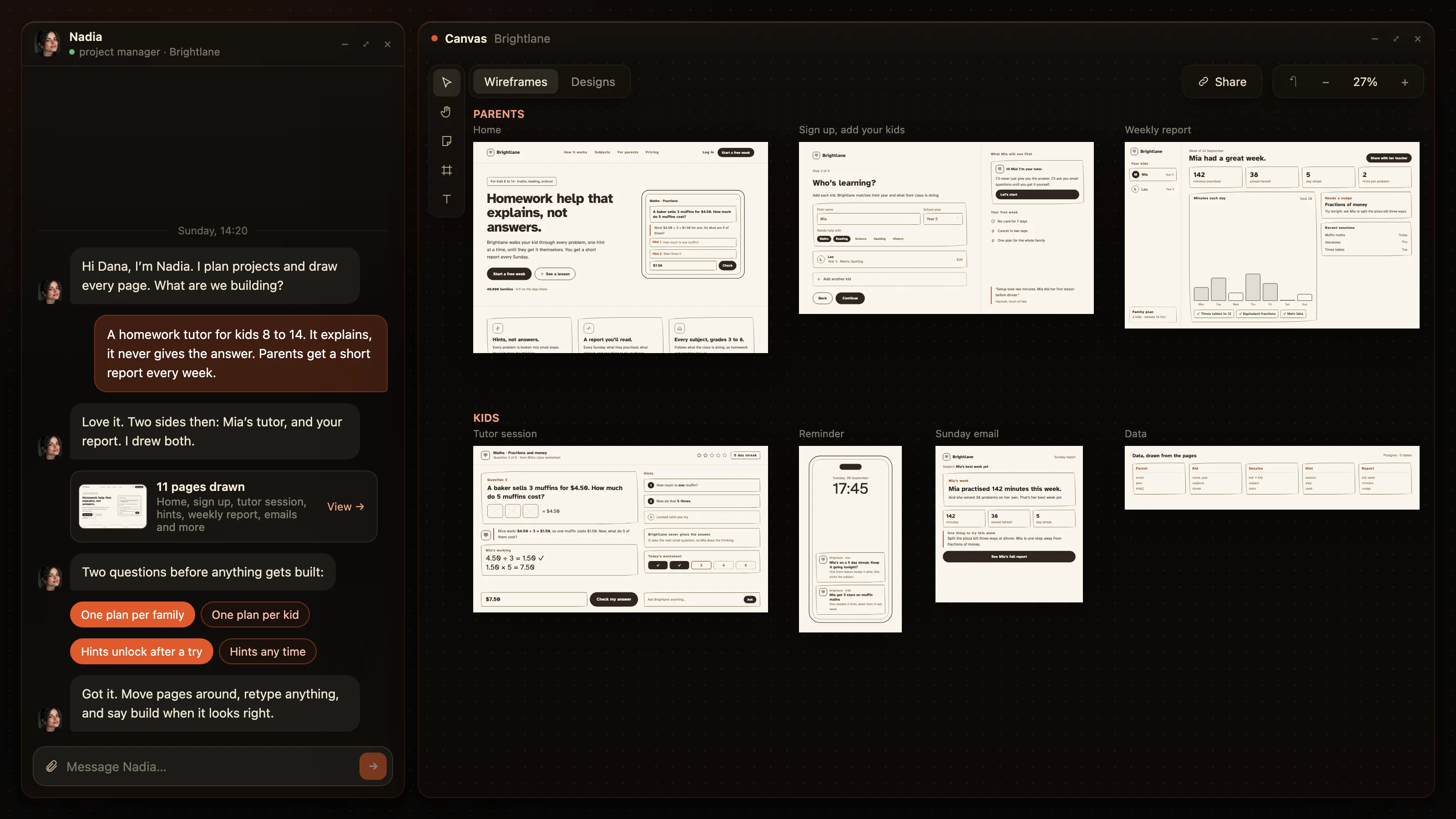
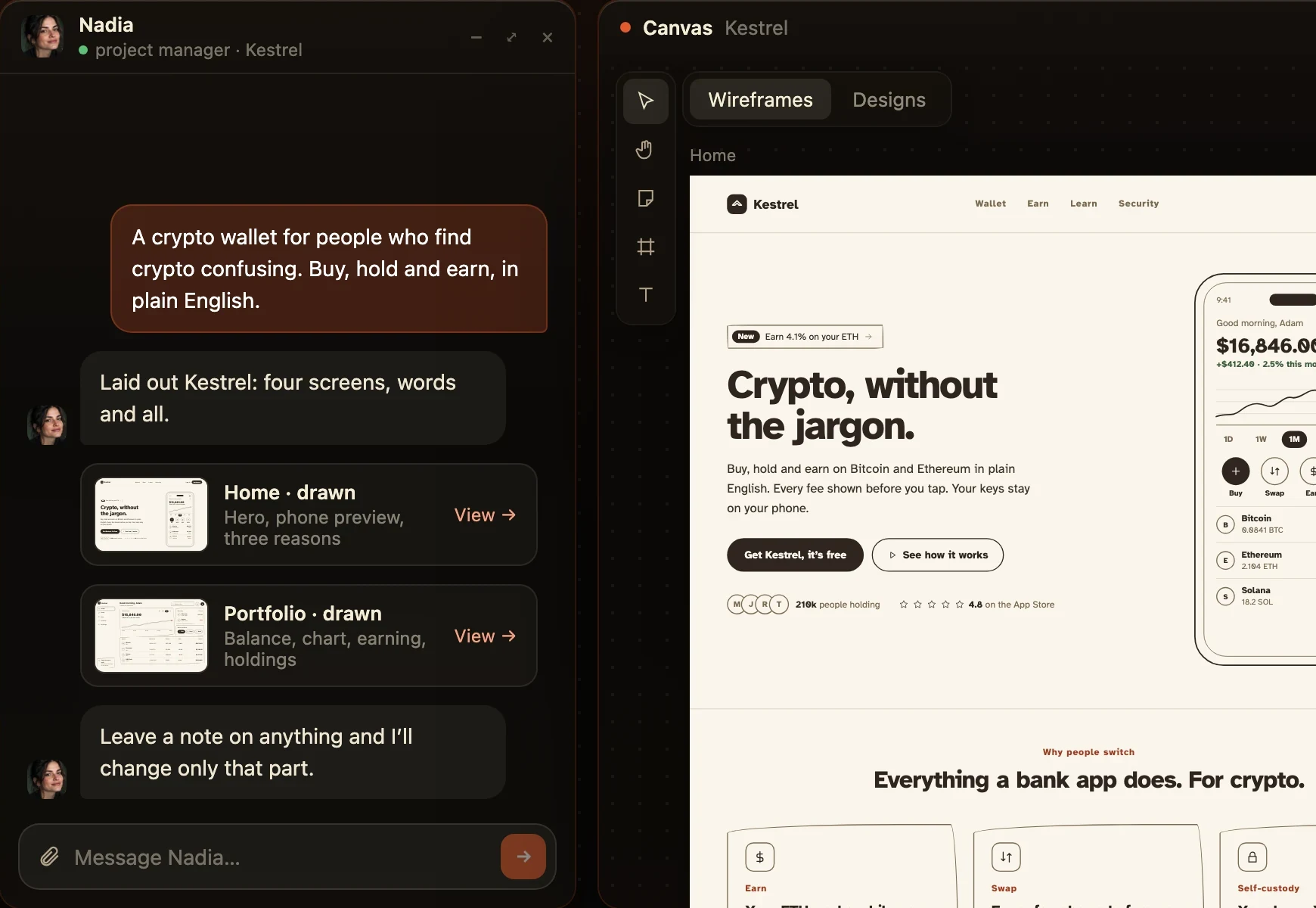
Four screens to start: Pipeline, Deal detail, Pricing page, Schema. I have put the words on them, so read them before Devi sees any of it.
added 4 boardsBilling wants a plan table and an invoice list, so that is two boards, not one. Drawing both.
added Billing, InvoicesEverything on one canvas.
Every page, drawn and worded, before anything is built.
Who this is for
Primary persona: Maria and Tom. Two people sharing one pipeline at a twelve-person company. Maria closes, Tom follows up. Neither has ever opened a CRM they liked.
What they are actually buying
- One list both of them trust, instead of two spreadsheets
- Knowing what to do next without a standup to decide it
- Something that survives one of them being on leave
Pain to mirror in the copy
- “Every CRM is built for a sales team of nine”
- Data entry that costs more than the deal is worth
- Reports nobody on a two-person team reads
Competitive frame
Not competing with Pipedrive on features. Competing on the half hour a week it takes to keep it true. The wedge is two people, one list, not “also works for small teams”.
Objections to answer before the fold
- “We already have a spreadsheet” → show the two-column import
- “What happens when we hire a third?” → seats, not tiers
Pipeline
New dealSorted by last touched. Nothing here is a stage nobody uses.
Visual direction for Anouk
- Mode: light, paper-first. This gets read at a desk, not on a phone
- Accent: one colour, used for state and nothing else
- Type: one humanist sans. Numbers tabular, so columns line up
- Density: eight deals on screen without scrolling
Reference
- Linear’s list density, Stripe’s number formatting
- Nothing that needs a second click to read a deal
Open questions before build
- Does a deal belong to a person or to the team?
- Is “won” a stage or a date?
- Do we show currency on every row, or once in the header?
Billing
Invoices
Plan table and invoice list stay two boards, not one.
keep them apart
Who this is for
Primary persona: Maria and Tom. Two people sharing one pipeline at a twelve-person company. Maria closes, Tom follows up. Neither has ever opened a CRM they liked.
What they are actually buying
- One list both of them trust, instead of two spreadsheets
- Knowing what to do next without a standup to decide it
- Something that survives one of them being on leave
Pain to mirror in the copy
- “Every CRM is built for a sales team of nine”
- Data entry that costs more than the deal is worth
- Reports nobody on a two-person team reads
Competitive frame
Not competing with Pipedrive on features. Competing on the half hour a week it takes to keep it true. The wedge is two people, one list, not “also works for small teams”.
Objections to answer before the fold
- “We already have a spreadsheet” → show the two-column import
- “What happens when we hire a third?” → seats, not tiers
Pipeline
New dealSorted by last touched. Nothing here is a stage nobody uses.
Visual direction for Anouk
- Mode: light, paper-first. This gets read at a desk, not on a phone
- Accent: one colour, used for state and nothing else
- Type: one humanist sans. Numbers tabular, so columns line up
- Density: eight deals on screen without scrolling
Reference
- Linear’s list density, Stripe’s number formatting
- Nothing that needs a second click to read a deal
Open questions before build
- Does a deal belong to a person or to the team?
- Is “won” a stage or a date?
- Do we show currency on every row, or once in the header?
Billing
Invoices
Plan table and invoice list stay two boards, not one.
keep them apart
Four screens to start: Pipeline, Deal detail, Pricing page, Schema. I have put the words on them, so read them before Devi sees any of it.
added 4 boardsBilling wants a plan table and an invoice list, so that is two boards, not one. Drawing both.
added Billing, InvoicesSeven specialists,
one canvas.
Nadia and Devi are on every project. Hire the rest when needed.

Nadia
Turns your prompt into boards, and keeps them current.

Jonah
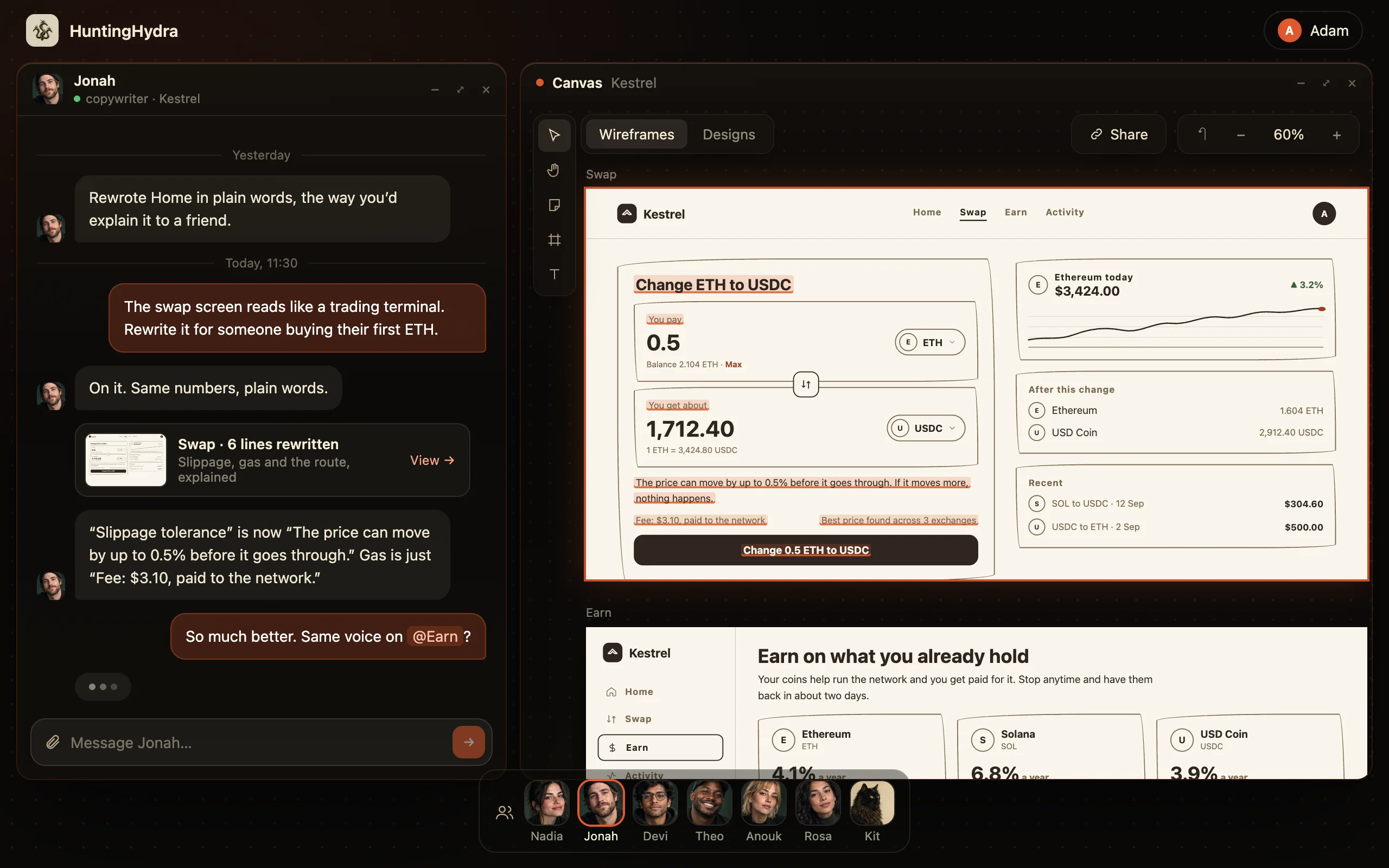
Rewrites every line so a person could have written it.

Devi
Builds the canvas into a live app, then owns it.

Theo
Picks one launch channel and writes the assets.

Anouk
Designs over the wireframes once you pick a direction.

Rosa
Adds the pages people search for, and the mail that keeps them.

Kit
Wires the step you keep doing by hand.
All seven,
every project.
From $20 a month.
Prompt-and-pray is over.
A text box answers forty questions without asking you. Here is one.
builder
A text box picks for you. Here you pick, while it is free.
There are two ways
to build software with AI.
A text box, or stages with specialists and a place for you.
- You write the spec. You wait.
- The design comes back. You text changes. You wait.
- Weeks later, a developer builds what they understood.
happens without you
- You say what you are building.
- Nadia draws it as boards, the same hour.
- You say what is wrong. It changes.
- Anouk designs it. Jonah writes it.
- Devi builds exactly that.
- You get a URL, a database, and the code in your GitHub.
One sentence in.
A product out.
What you typed, and what was running four days later.
It also works on things
you already shipped.
Point it at a live codebase. It draws the spec nobody wrote.
project manager
Point me at the repo. I read what is there.
No build phase. Boards from the real code.
The most creative you’ll
ever be with a computer.
Use the Claude, ChatGPT or Codex you already pay for.
- All seven agents
- Runs never metered
One product, sentence to live URL.
- One project in flight
- Postgres behind it, schema drawn first
Ship something every month.
- Several projects at once
- Point it at repos you already have
Your whole team on one canvas.
- A workspace for every product
- Shared canvases the team edits live
Does it run on my own Claude or ChatGPT subscription?
Yes, on the $20 plan, unmetered. From Starter up it runs in the dashboard instead.
What actually ships at the end?
A Next.js app with Postgres, auth and a live URL with SSL.
Do I own the code?
Yes. It is in your GitHub from the start, and keeps running if you leave.
Can it work on something I already shipped?
Yes. Point Nadia at the repo and she draws boards from the real code.
What if I would rather two humans did it?
The HuntingHydra studio does the work for you. Sprints start at $5,000.